
Silestone vs Dekton: what material to choose for a countertop?
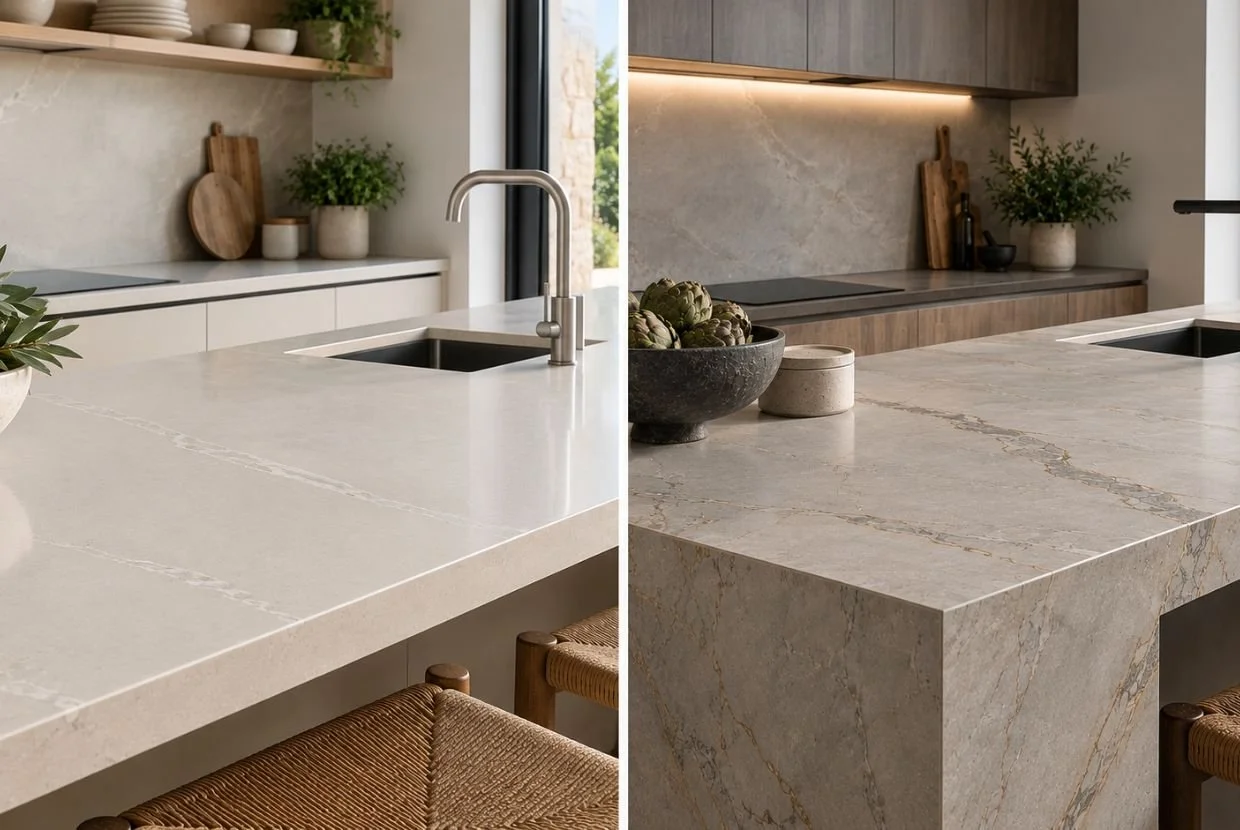
When designing a kitchen, choosing the countertop goes far beyond choosing a color or finish. It is a surface that will be exposed daily to heat, stains, humidity, shocks and continued use, so the material must respond to the real needs of the space.
Among the best-known options are Silestone and Dekton, two surfaces developed by Cosentino that share some features, but present important differences in terms of composition, resistance and application possibilities.
So which one is most suitable for a kitchen? The answer depends on the use it will receive, the design sought, and the features we actually need.
Silestone vs Dekton: how are they different?
Although at first glance they may seem like very similar alternatives, it is not the same type of material. Silestone is a hybrid mineral surface made from a combination of minerals and recycled materials using HybriQ+ technology, while Dekton is an ultracompact surface made from a mixture of minerals subjected to a compaction and sintering process.
This difference in its manufacturing directly influences its characteristics.
Silestone is specially designed for indoor applications and offers high resistance to stains, scratches and impacts. That is why it is commonly used on kitchen and bathroom countertops.
Dekton, for its part, takes its performance a step further in certain aspects. Its resistance to heat, ultraviolet radiation and environmental conditions allows it to be used both indoors and outdoors. In addition to countertops, it can be used in coverings, floors, furniture, bathrooms or facades.
Therefore, it is not simply a matter of deciding which material is best, but of determining which best meets the demands of each project.
Which material is best resistant to heat?
This is one of the most relevant differences when we talk about kitchen countertops.
Silestone has good heat resistance, but it is recommended to avoid direct and prolonged contact with containers at very high temperatures. As with many countertop surfaces, using trivets is a simple measure to protect the material.
Dekton offers superior thermal resistance. Its composition and manufacturing process allow it to withstand high temperatures and, according to the manufacturer's instructions, it can resist point contacts of up to 300 ºC.
This is especially practical in a kitchen where hot pots, pans and containers are frequently cooked and handled.
However, just because a surface has high thermal resistance does not mean that any situation is advisable. Sudden temperature changes or continued exposure to very intense heat sources can cause problems in any material. Following the manufacturer's installation and maintenance recommendations will always be important.
Silestone vs Dekton facing bumps and scratches
At this point the comparison becomes more interesting because each surface has its own strengths.
Both offer high scratch resistance and are designed to withstand everyday kitchen use. However, Silestone stands out especially for its impact resistance.
Dekton, on the other hand, has very high hardness and surface resistance, which makes it an especially interesting option when looking for a surface capable of withstanding demanding use.
The installation also plays a role. The edges, sink and plate holes, corners and areas with less support require correct execution to prevent a blow from causing damage.
Therefore, rather than solely assessing the technical characteristics of the material, it is important to consider how the countertop will be designed and manufactured.
Which one is more resistant to stains?
A countertop is constantly exposed to substances that can leave marks: oil, coffee, wine, tomato, citrus fruits or different cleaning products.
Both Silestone and Dekton have high stain resistance thanks to the low porosity of their surfaces. This considerably facilitates its maintenance and avoids having to carry out periodic sealing treatments as occurs with some natural stones.
Still, stain resistance doesn't mean we can leave any substance on the counter indefinitely. Quick cleaning after a spill will always be recommended, especially with highly pigmented products.
For daily maintenance, it is usually enough to use soap and water or a product suitable for this type of surface. It is also important to avoid abrasive products or substances that could deteriorate the finish.
Silestone or Dekton for a kitchen?
The choice can change quite a bit depending on how the space is used.
For a conventional indoor kitchen, Silestone can offer all the features necessary to achieve a resistant countertop, easy to maintain and with a wide variety of aesthetic possibilities.
It is an especially interesting option when looking for a balance between design, functionality and budget.
Dekton makes more sense when additional features are needed. For example, it may be a particularly suitable choice for an outdoor kitchen, a home where cooking is done a lot, or a project where the countertop is integrated with other coverings.
It can also be interesting on large islands, where format and visual continuity play a significant role in the design.
In short, it does not always make sense to choose the most technically resistant material. If the conditions of use do not require those additional features, a surface like Silestone may be perfectly suitable.
What options does each design material offer?
Aesthetics is another factor that can tip the decision.
Both Silestone and Dekton feature a wide variety of colors, patterns and finishes. There are proposals that reproduce the appearance of natural stones, marbles or mineral materials, as well as more uniform and contemporary options.
The choice should be made taking into account the kitchen as a whole: furniture, flooring, cladding, lighting and architectural style.
In a minimalist kitchen, for example, a large-format surface with few joints can help create a cleaner, more continuous feel. In other projects, a countertop with the appearance of natural stone can become one of the main elements.
It is also worth evaluating the finish. A matte surface can offer a more understated and contemporary aesthetic, while certain polished finishes provide luminosity and a different appearance.
Can Dekton be used outdoors?
Yes, and this is one of its main advantages over a surface designed primarily for interiors.
Dekton has high resistance to ultraviolet radiation and environmental conditions, so it can be used on terraces, outdoor kitchens and other spaces exposed to the sun and the elements.
This opens up many possibilities in residential projects where interior and exterior are increasingly connected.
The same surface can be used, for example, for an indoor countertop and visually continue towards an outdoor area, provided that the project and characteristics of the chosen model allow it.
Silestone, on the other hand, is primarily geared towards indoor applications, so it would not be the usual choice for a countertop permanently exposed to outdoor conditions.
Which is more expensive: Silestone or Dekton?
There is no universal price difference between the two materials. The final cost depends on the model chosen, the format, the thickness, the finishes and, especially, the work required to manufacture and install the part.
Sink or plate cuts, special edges, joints, machining, and installation complexity can significantly influence the budget.
In many projects, Dekton involves a larger investment, but it should not be valued solely from the price per square meter. If its features allow other parts of the project to be resolved, using the same material on the countertop, coverings or exterior can provide coherence and simplify the choice of materials.
The best option will therefore be the one that provides the necessary features without overpaying for features that we will not take advantage of.
Which one to choose according to the type of project?
A simple way to make the decision is to start with the use and not the name of the material.
For an everyday indoor kitchenSilestone can be a very balanced option thanks to its durability, ease of cleaning, and design possibilities.
For a heavy-duty kitchenDekton can be especially interesting because of its resistance to heat and wear.
For an outdoor kitchenThe resistance to UV rays and environmental conditions makes Dekton a much more suitable alternative.
For those who prioritize impact resistanceSilestone has a strong point that should be taken into account.
For projects where the surface continues through walls, furniture or floorDekton offers many possibilities thanks to its features and formats.
Therefore, before choosing a countertop, it is advisable to analyze how the kitchen is used, what level of maintenance is expected, what aesthetics are sought and what budget exists. The decision should be part of the interior design project and not made in isolation.
Cristina Garau Interior Design: choosing the right materials for each space
In an interior design project, the choice between Silestone, Dekton or other surfaces does not depend solely on their technical characteristics, but on how they fit into the whole of the home and the way of living it. In Cristina Garau Interior Design, as interior design studio in MallorcaWe can help you evaluate the different options and find the materials that best suit your project. Contact our team and tell us what space you want to transform.