
Microcement Flooring in Bathrooms: Pros and Cons
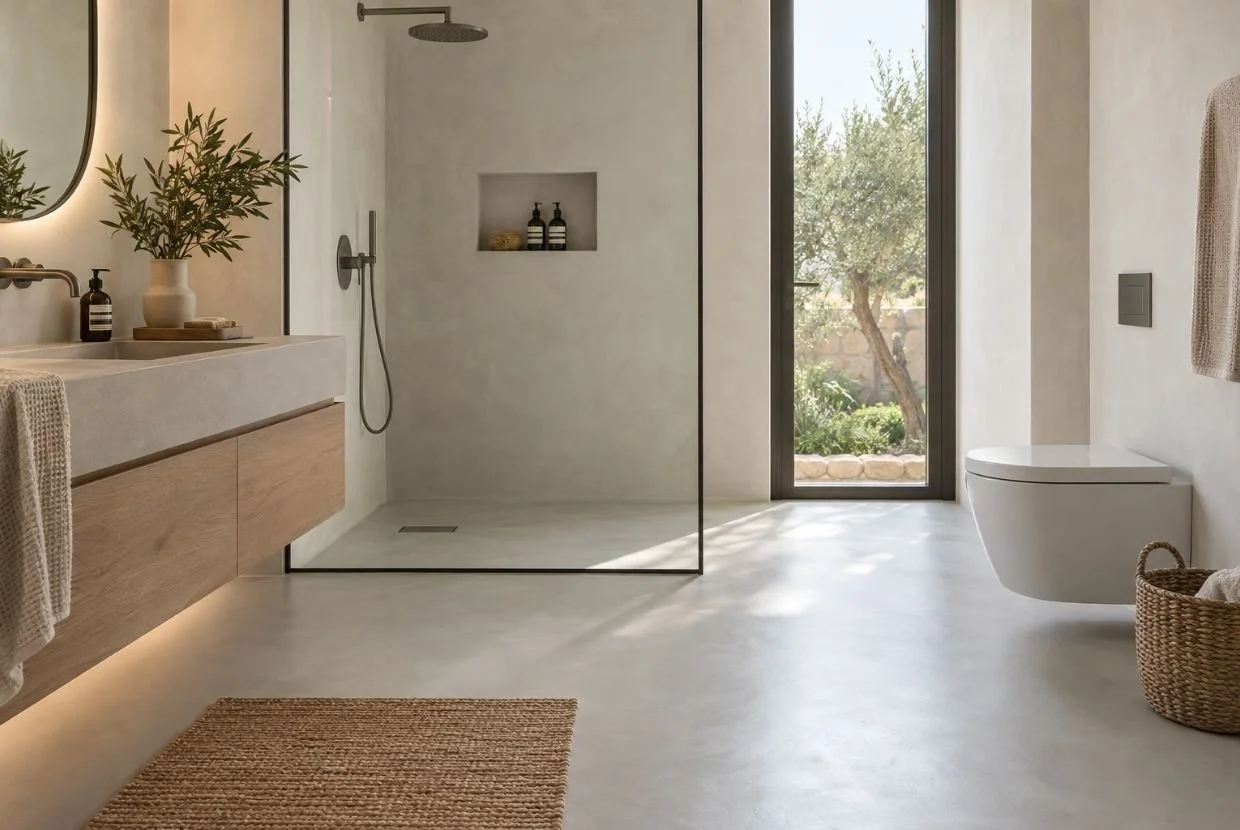
Microcement has become one of the most used finishes in contemporary interior design projects, especially when looking for a clean, continuous and jointless aesthetic. In the bathroom, this solution allows you to cover both walls and floors and create a very uniform image, but it also raises some questions: is it really waterproof? Can it be used in the shower? Does it crack? Does it require a lot of maintenance?
Before choosing it, it is advisable to know both its possibilities and its limitations. The final result depends not only on the material, but also on the preparation of the support, the system used and, especially, the quality of the application.
What is microcement and why is it used in the bathroom?
Microcement is a very thin decorative coating, generally composed of a cementitious base combined with resins, aggregates and pigments. One of its main characteristics is that it can be applied to different surfaces without the need for complete demolition, as long as the support is in good condition.
In bathrooms it is used on walls, floors, countertops, furniture and shower areas. Its main attraction is the possibility of achieving a continuous surface, without the usual tile joints.
This feature also has an important aesthetic consequence: by eliminating visual interruptions, the space acquires a more uniform appearance. In small bathrooms, this effect can help the whole feel wider and clearer.
Microcement flooring in bathrooms: main advantages
A continuous, jointless surface
The absence of joints is probably one of the main reasons why this finish has become popular in interior design. A continuous pavement allows for the creation of a visually uniform surface, especially interesting in minimalist, Mediterranean or contemporary projects.
It also facilitates daily cleaning, since there are no joints between pieces where dirt, moisture or product remains can accumulate.
That doesn't mean maintenance is non-existent. The surface needs to properly retain its protective layer to maintain its performance against everyday use.
A very versatile aesthetic
Another of its advantages is the ability to adapt to different styles. Although traditionally associated with gray tones and an industrial aesthetic, there are currently numerous colors, textures and finishes.
Sand, beige, stone or off-white tones can work especially well in Mediterranean-inspired bathrooms, while dark grays can provide a more sophisticated image.
Furthermore, by using the same finish on floors and walls, it is possible to create a sense of continuity that is difficult to achieve with materials placed using independent pieces.
It allows you to renew without necessarily lifting the entire bathroom
One of the most interesting possibilities of this material is its application on certain existing coatings. If the tiles are properly adhered and the support is free of problems, it may be possible to place the new finish on them after properly preparing the surface.
This can reduce the amount of debris and demolition work during a renovation.
However, it should not be interpreted as a solution that allows any surface to be covered directly. Loose parts, irregularities, unstable joints or humidity problems must be resolved in advance.
Little thickness
The reduced thickness of the system is another advantage when you want to reform without modifying the existing levels too much. This can be especially useful in certain bathroom renovations where raising the pavement would complicate encounters with doors, toilets or other elements.
What are the drawbacks of microcement flooring in bathrooms?
The image of a continuous, resistant and practically maintenance-free material can be attractive, but there are some aspects that should be assessed before deciding.
It is not waterproof on its own
One of the most widespread ideas about microcement is that, because it is used in bathrooms, it constitutes an impermeable barrier. That's not the case.
The coating needs an adequate protection system and, where necessary, proper waterproofing of the support. In a shower, for example, microcement itself should not be considered as a substitute for waterproofing. Water resistance depends on the system as a whole and how it was executed.
For this reason, prior preparation is as important as the finish seen once the project is finished.
It is very sensitive to the quality of the installation
Microcement is applied in very thin layers, so support conditions are of considerable importance. If there are movements, cracks, poorly resolved joints or structural problems on the lower surface, these can end up manifesting themselves in the finish.
Poor application can also cause texture differences, changes in tone, or sealing-related problems.
Therefore, rather than simply looking for a specific product, it is important to ensure that the professional installing it has specific experience with this type of coating.
Cracking may appear
The risk of cracks appearing is one of the aspects that most worries those considering using this material. Microcement is not usually the original cause of movement, but being a thin coating it can reflect movements or problems existing in the support.
Proper preparation, joint treatment, and the use of the appropriate system are essential to minimize this risk.
The floor finish must be chosen carefully
Not all finishes offer the same characteristics against slippage. In a bathroom, where the floor can regularly come into contact with water, this issue takes on special importance.
Therefore, it is not enough to ask if microcement is "non-slip". An appropriate finish must be specified for the intended use, especially if it is to be used inside a shower.
What maintenance does this type of pavement require?
Although the absence of joints makes cleaning easier, the pavement is not completely immune to wear. The sealing layer is especially important because it protects the finish from water, stains, and everyday use.
For maintenance, it is recommended to use appropriate cleaning products and avoid excessively aggressive or abrasive substances that could deteriorate surface protection.
It is also important to pay attention to the manufacturer's specific instructions, as microcement systems are not all created equal and their maintenance needs may vary.
In other words, it is a relatively simple material to maintain on a daily basis, but it needs to have been properly sealed and cared for to retain its long-term performance.
Microcement or porcelain: what is better for a bathroom?
There is no universal answer. The choice depends on the project's priorities.
Porcelain offers a well-established solution for wet areas and is available in a huge variety of formats, colors, and finishes. It also allows materials such as stone, wood or cement to be imitated with an increasing level of realism.
Microcement, on the other hand, stands out when you are looking for a continuous surface, without joints and with a more artisanal aesthetic. It can also be particularly interesting in certain renovations where the aim is to transform the space without removing all the existing cladding.
Therefore, it is not so much a matter of deciding which is "best" in absolute terms, but which best meets the needs of the bathroom, the budget, the level of maintenance that is desired to be assumed and the aesthetic result sought.
Is it worth investing in microcement flooring in bathrooms?
The answer can be yes, provided its characteristics are well understood and it is executed correctly.
It is a particularly interesting alternative for those looking for a bathroom with a contemporary aesthetic, continuous surfaces and a more serene and uniform image. It can also be a good option for certain renovations where it is important to work on existing cladding and reduce demolition.
But it shouldn't be chosen solely for its appearance. In a humid space, issues such as waterproofing, slip resistance, sealing and support preparation are decisive.
Therefore, if the project requires a lasting solution, it is advisable to value the material within the overall design and not as an isolated element. The choice of finish, colors, sanitary ware, lighting and other materials will be what really determines the final result.
Design a bathroom with microcement with Cristina Garau Interior Design
Choosing a bathroom lining is only one part of the project. In Cristina Garau Interior Design We study the space as a whole to find materials, layout, colors and finishes that meet both the needs of each home and its aesthetics. If you are considering incorporating this type of pavement into your renovation, contact our interior design studio in Mallorca and we will help you find the most suitable solution for your bathroom.