
Parquet or Tarima for an Office? Which one to choose?
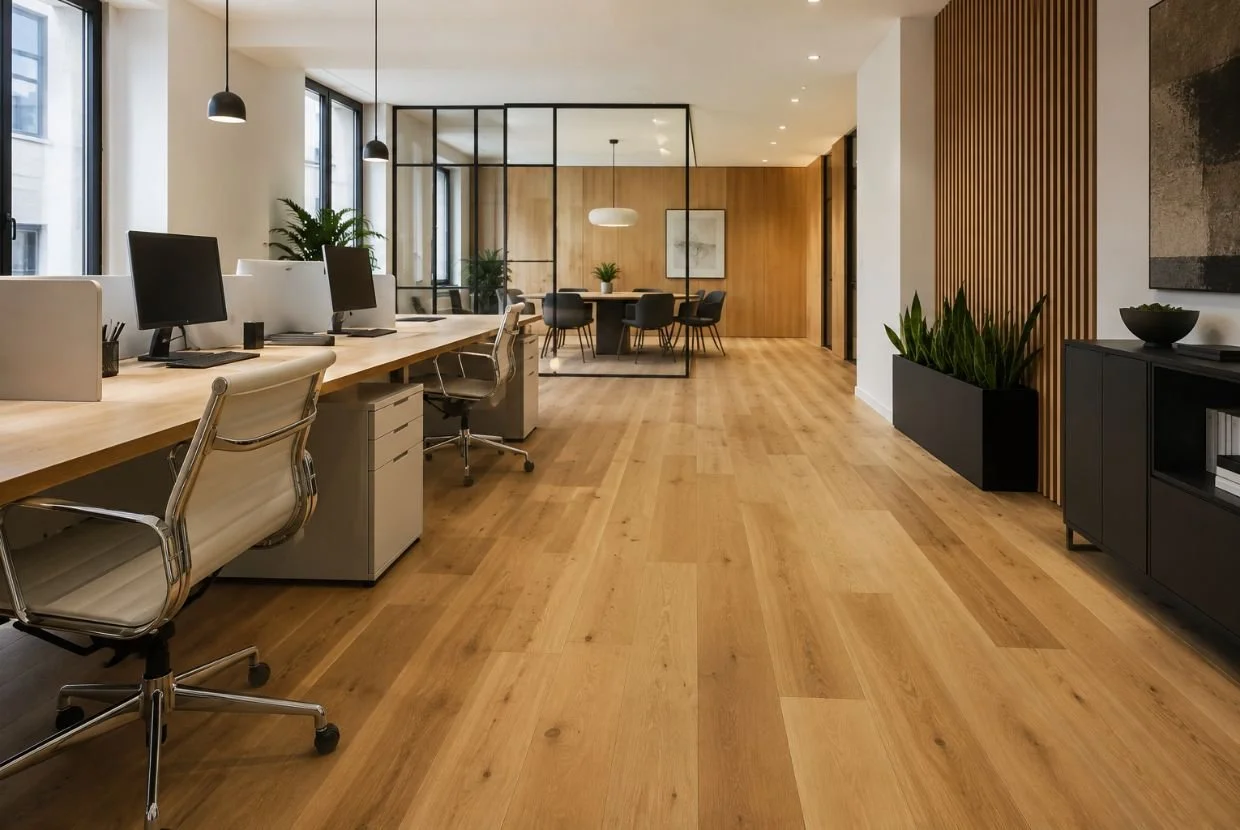
Choosing the right flooring for a workspace is not just an aesthetic issue. In an office, the floor has to withstand daily traffic, wheelchairs, furniture movement and, in some cases, much more intense use than we find in a home. At the same time, it is one of the elements that most conditions the perception of space: it can make it warmer, more elegant and welcoming or, on the contrary, convey an image that is too cold or impersonal.
Therefore, when the doubt arises, parquet or flooring for an officeIt is worth valuing something more than the appearance of the wood. The type of material, its strength, installation, maintenance, and the specific use the space will have are factors that should be included in the decision.
What is the difference between parquet and platform?
Before choosing, it is important to clarify that the terms parquet and platform They are often used interchangeably, although technically they do not mean exactly the same thing.
Parquet refers to a wooden pavement, usually made up of pieces that allow the creation of different compositions and patterns, such as herringbone, checkerboard or more traditional designs. Natural wood provides a unique appearance, as each piece features variations in tone, grain, and texture.
The platform, on the other hand, is usually associated with larger format slats. It can be made of natural wood, multi-layered or even laminated, so simply talking about “deck” does not necessarily determine what material we are choosing.
In fact, one of the most interesting options for professional spaces is the multi-layer natural wood flooring. It is made up of several layers that improve its dimensional stability and has a top layer of hardwood.
Therefore, rather than keeping the product name, the important thing is to know its characteristics and verify that they meet the needs of the office.
Parquet flooring or office flooring: which option is more durable?
In a workspace, resistance should be one of the first issues raised.
An office can receive many footsteps throughout the day and, in addition, wheelchairs generate different wear and tear than a home. You must also take into account the legs of the tables, the movement of filing cabinets and other furniture elements.
If you choose laminate flooring, for example, it is advisable to look for products specifically intended for professional use. The class 33 It is associated with intensive commercial use and there are AC5 laminates prepared for offices and other elevated transit spaces.
This does not mean that natural wood is not suitable for an office. On the contrary: a quality wooden pavement can offer great durability and, depending on the system and finish, can be restored by sanding when the passage of time leaves its mark.
The key is to choose the product based on the intensity of use and not just its appearance.
Parquet or flooring for an office with a lot of traffic?
If we're talking about an open-plan office with many people working, frequent visits, and heavy use of wheelchairs, a high-performance laminate can be a particularly practical alternative.
In contrast, in a professional office, meeting room, or office where design plays a significant role, natural wood can provide a level of warmth and sophistication that is difficult to achieve with other materials.
The decision, therefore, should not be based solely on which of the two materials is “stronger”. We must ask ourselves what use each area will have and what image you want to convey.
Multi-layer flooring: a very interesting middle ground
When looking for natural wood but also stability and functionality, multi-layer flooring can be one of the most balanced solutions.
Its structure combines a top layer of fine wood with other layers that help reduce natural wood movements caused by changes in temperature and humidity.
Furthermore, it can be installed using different systems. In an office, glued placement can be especially interesting because it provides a more solid feel and reduces certain vibrations and noises associated with footsteps. It can also promote the acoustic behavior of the pavement.
Another advantage is that it allows working with large slats, something that can be very attractive in contemporary projects. Long, wide pieces help create a visually continuous surface and make the space appear larger.
Therefore, if the goal is to achieve a professional interior but far removed from the cold aesthetic of some traditional offices, this alternative deserves to be considered.
What if we look for a cheaper option?
It is not always necessary to resort to natural wood to achieve the effect we are looking for.
Currently there are laminate floors with finishes that reproduce different species of wood quite faithfully. A good quality model can offer a convincing appearance while making daily maintenance easier.
For an office where strength, easy cleaning, and budget control are the priority, a commercial laminate can make a lot of sense. Some AC5 class 33 models are specifically designed for professional spaces and withstand heavy use.
It can also be a good solution when you want to renovate an office without carrying out an overly complex intervention. Click-on installation systems allow for relatively quick placement and some products can be used over low-temperature radiant heating systems.
However, not all laminates are the same. For an office, it wouldn't make sense to choose solely based on color or price. Always review the type of use, abrasion resistance, behavior in front of wheelchairs and the manufacturer's specific recommendations.
The finish matters too
Once the material has been decided, another issue arises that can completely change the result: the finish.
For modern offices, natural wood tones often work especially well. A light oak, for example, can provide luminosity and easily combine with white walls, stone tones, natural textiles or wooden furniture.
Midtones add a bit more character and can be interesting in offices or corporate spaces looking for an elegant image. In contrast, very dark woods require more care in composition because they can make a small room appear visually heavier.
It is also advisable to assess the surface finish. Excessively shiny finishes can be less natural and make certain brands more visible. A matte or ultramate surface is usually best integrated into contemporary interiors.
And there is another aspect that is often overlooked: the pavement does not have to be exactly the same in all areas. In an interior design project, materials can be combined to differentiate work areas, reception areas, rest areas or meeting rooms, provided there is a visual relationship between them.
Parquet or platform for an open office?
In open-plan offices, the floor takes on even more prominence because it occupies a considerable surface area and visually connects different areas.
In this type of spaces, light or medium-toned wood can help create continuity and provide warmth without competing with furniture. Long slats can also help reinforce the feeling of spaciousness.
But in an open office there is another important factor: acoustics.
The noise of footsteps, conversations, and constant movement can become a problem when several people share the same space. Therefore, the choice of pavement should be part of a broader acoustic strategy that includes roofs, cladding, textiles, sound-absorbing panels and furniture.
A properly planned installation can also improve the feeling of solidity and comfort of the floor. On certain multi-layer wooden decking, glued placement can help reduce noise associated with footsteps.
What to choose depending on the type of office
There is no single valid answer for all projects. A small office with few employees has different needs than a large corporate space.
For one office with high trafficA high-performance laminate, such as a Class 33 AC5, can be a practical and durable option.
For a professional office or studyNatural wood can provide a more sophisticated and personalized image.
For one design office, architecture or interior design, a multi-layer flooring can offer that balance between materiality, aesthetics and performance that allows the pavement to be part of the project itself.
And for one meeting room or representative areaIt may also make sense to use a more decorative pattern, such as a herringbone, to differentiate it from the rest of the space.
Ultimately, the choice between parquet or flooring for an office It should always start from the complete project: who will use the space, how much traffic it will have, what furniture will be installed, what maintenance is being undertaken, and what feeling is being conveyed.
Cristina Garau Interior Design: office design in Palma de Mallorca
Choosing the right pavement is only one part of a professional renovation. Distribution, lighting, materials, furniture and acoustics must work together to achieve an office that is functional and consistent with the identity of each company. In Cristina Garau Interior Design We develop customized projects of office renovation in Palma de Mallorca, adapted to the needs of each space and the image that is to be transmitted. If you are thinking of renovating your office, contact Cristina Garau Interiorismo and we will study with you how to transform the space.