

Interior design is constantly evolving, but some trends manage to remain relevant generation after generation. This is the case of Mid Century Modern style, a trend that It was founded in the mid-20th century and continues to inspire homes, hotels, and commercial spaces thanks to its combination of functionality, simplicity and personality.
Its aesthetic is recognized by the presence of warm woods, furniture with refined lines, organic shapes and colors that provide character without saturating the environments. However, behind this appearance lies a much broader design philosophy, related to architecture, innovation in materials, and a new way of understanding domestic spaces.
Knowing its origins and characteristics allows us to identify what elements define it and how to incorporate them into a current home without turning it into a reproduction of the fifties.
1. The origin of the Mid Century Modern style: a new way of living
The movement emerged between the 1940s and 1960s, in a context marked by social and technological changes after World War II. Economic recovery and industrial advances spurred new ways of manufacturing furniture and building homes.
Although its roots lie in European modernism, especially in the ideas of the Bauhaus and functionalist design, it was in the United States where it acquired its own identity. California became one of its main settings, with homes seeking to take advantage of natural light, connect interiors with the landscape and eliminate unnecessary architectural barriers.
Mass production also allowed experimentation with materials such as molded plywood, fiberglass and different types of plastic. This opened up new possibilities for creating furniture that is lighter, more accessible and adaptable to the needs of everyday life.
The main idea was simple: design comfortable, practical and aesthetically balanced spaces, without resorting to unnecessary ornaments.
2. Simple lines and organic shapes: the balance of furniture
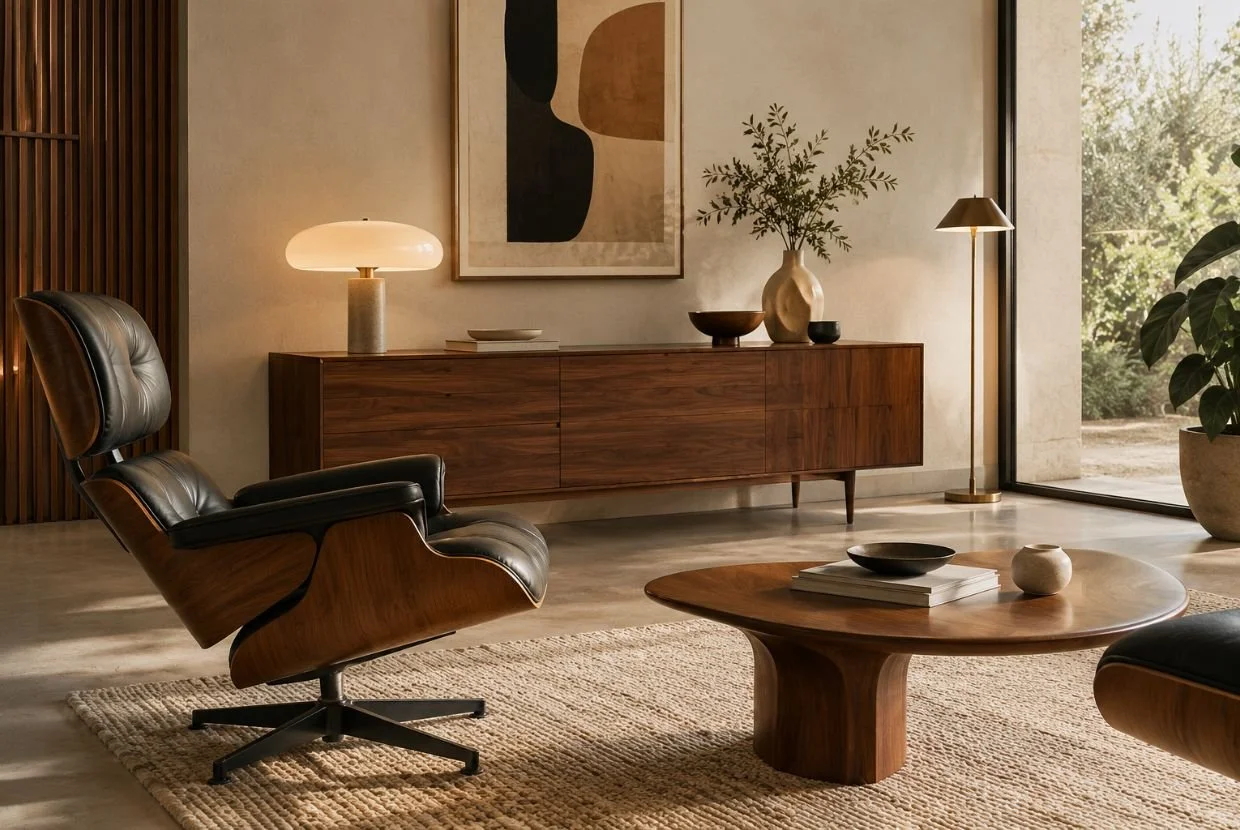
One of the most recognizable characteristics of this movement is the combination of geometry and natural shapes. The furniture features refined structures, stylized profiles and balanced proportions, but also incorporates curves that soften the overall effect.
The oval tables, the wraparound seats, the rounded backrests and the inclined legs These are some of its usual elements. Also noteworthy are the low, elongated sideboards, which provide visual continuity and maintain a feeling of spaciousness.
This furniture is usually raised slightly off the ground by means of thin, conical legs or legs open to the outside. This resource not only responds to an aesthetic issue: it allows light to circulate better and makes the pieces appear less bulky.
The absence of excessive ornamentation does not mean that the furniture is impersonal. On the contrary, its silhouettes have a sculptural presence that allows an armchair, a table or a lamp to become the center of attention in a room.
3. Wood and natural materials as protagonists
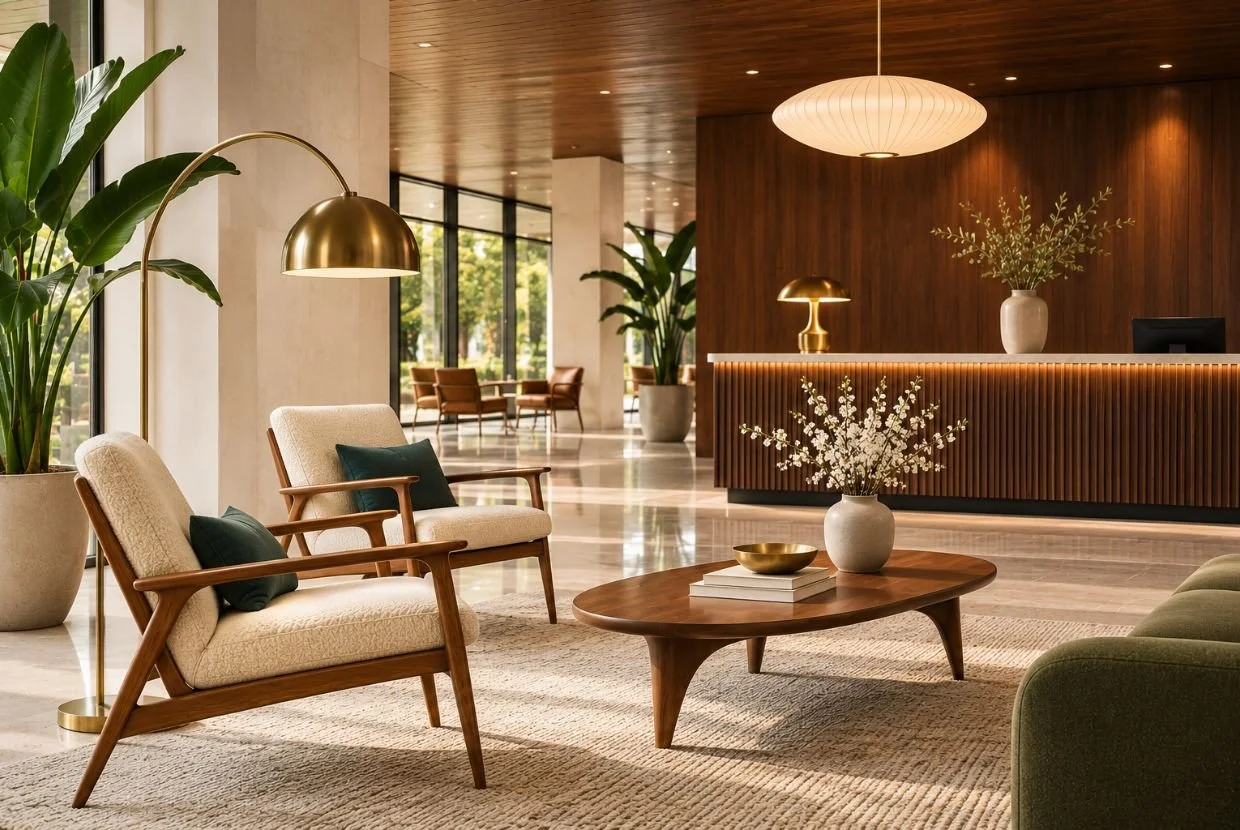
Wood is one of the fundamental materials in these interiors. The warm tones of walnut, teak, oak and rosewood add depth and contrast with lighter surfaces, such as glass or metal.
Finishes usually leave natural veins visible, avoiding overly shiny or artificial treatments. In this way, the material takes center stage due to its own texture and tone.
Alongside wood, other materials appear that reflect the experimental spirit of the time:
Metal: especially in structures of chairs, lamps and side tables.
Glass: used to visually lighten compositions and promote transparency.
Leather: present in seats and sofas, where it provides texture and elegance.
Molded plastics and fiberglass: employees to create seats with innovative shapes.
Stone and ceramics: incorporated into surfaces, accessories and decorative elements.
The mixture of natural and industrial materials is one of the keys to achieving a balanced environment and preventing the decoration from being too uniform.
4. Mid Century Colors: a warm palette with contrasts
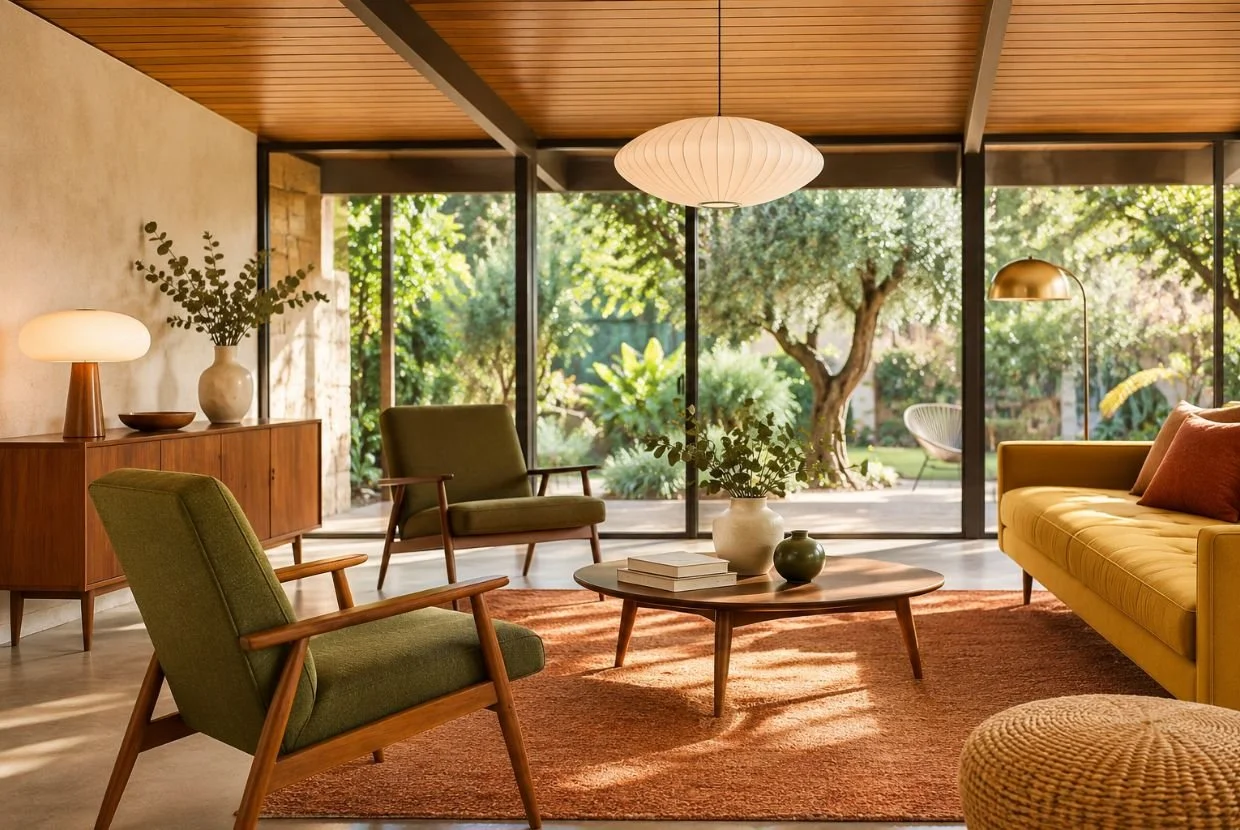
Chromatic choice also plays an important role. The base is usually built with neutral tones, such as off white, beige, sand o warm gray, which allow the materials and shapes of the furniture to be highlighted.
On this basis, more intense colors appear, inspired by nature and the graphic trends of the mid-20th century.
The mustard It provides light and is often used in upholstery or small accessories. The olive green introduces a visual connection with the outside, while the terracotta and he orange burnt adds warmth. They are also common oil blues and the deep browns, which generate interesting contrasts with the woods.
It is not necessary to use all these tones in the same room. A combination of two or three well-chosen colors is usually enough to achieve a coherent composition.
5. The iconic furniture that defined an era
To understand the influence of mid-20th century design, it is worth knowing some of the pieces and professionals who marked its evolution.
Charles and Ray Eames They revolutionized furniture with their experiments with molded wood and fiberglass. His Chair Lounge It is one of the most recognizable armchairs in the history of design.
Eero Saarinen It stood out for its sculptural forms and for the Tulip table, whose central base eliminates the traditional legs and achieves a visually light image.
Arne Jacobsen He designed pieces as well-known as the Egg chair and the Swan, characterized by their enveloping shapes. For its part, George Nelson He left an important mark with his lamps, clocks and geometric designs.
It also deserves special attention Florence Knoll, whose contribution was fundamental to integrating architecture, furniture and decoration into functional and well-organized spaces.
These creations demonstrate that furniture can go far beyond its practical usefulness: it can also define the visual identity of a home.
6. The connection between the inside and the outside
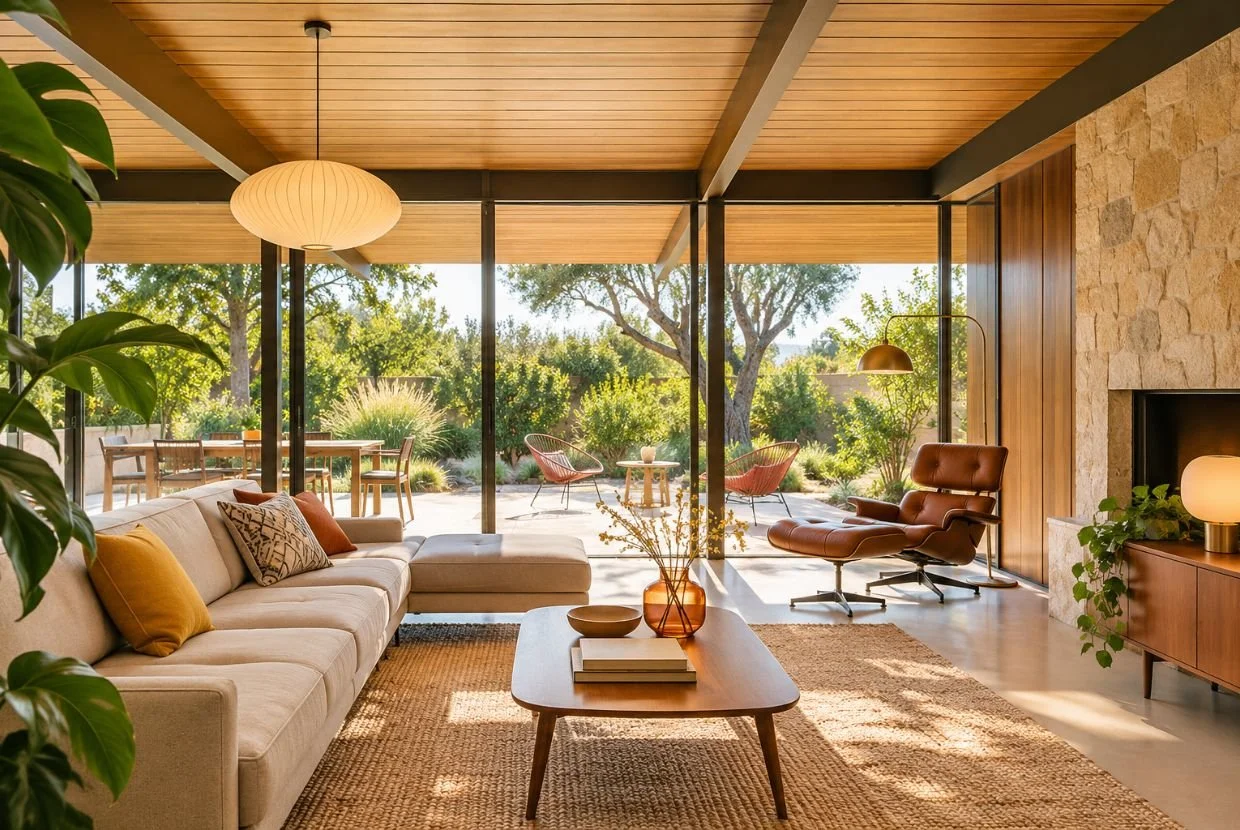
The architecture of this era attached great importance to the relationship between the house and its surroundings. The large windows, the sliding glass doors and the integrated terraces They allowed the landscape to be part of the inner experience.
Instead of excessively compartmentalizing the rooms, more open layouts and fluid visual routes were sought. Natural light became a fundamental element of the project and vegetation acquired a decorative and architectural role.
This philosophy still makes a lot of sense in today's homes, especially those with patios, gardens or terraces. Taking advantage of the views, choosing lightweight curtains, and maintaining a continuity of materials between interior and exterior are resources that help reinforce this connection.
7. Lighting and accessories: the details that give personality
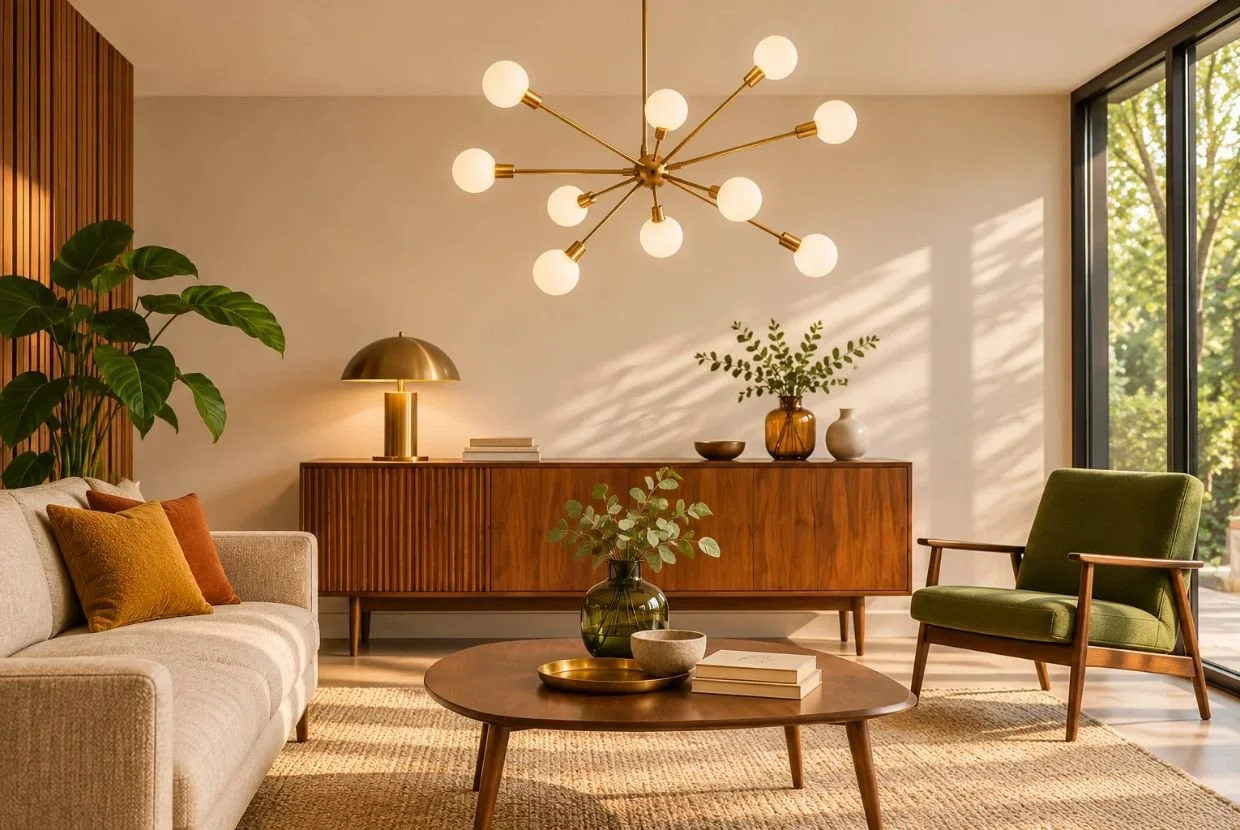
The lamps They play a special role in these environments. Their designs usually feature metal structures, articulated arms, geometric screens, or glass balloons. Some function practically like sculptures suspended or supported on furniture.
As for accessories, the following stand out: ceramic vases, the mirrors of organic shapes, the wall clocks and the works of abstract art. Geometric prints also appear on carpets, cushions, and other textiles.
Vegetation completes many of these compositions. Large-leaved plants provide contrast and help strengthen the relationship with nature.
The key is to select each element with intention. Accumulating too many objects can break the visual balance that characterizes this trend.
8. How to apply the Mid Century Modern style in a modern home
Incorporating this aesthetic does not imply reproducing a decoration from the fifties. A contemporary interpretation can combine vintage-inspired furniture with current materials, integrated storage solutions and a layout adapted to the needs of those who live in the home.
To achieve this, it is advisable start with a main piece, such as a walnut sideboard, an armchair with curved lines or an oval coffee table. From there, the rest of the environment can be built using a neutral chromatic base and materials that provide contrast.
It is also important to take care of the proportions. Low, visually lightweight furniture helps maintain a sense of spaciousness, while well-designed lighting allows textures and volumes to be highlighted.
The result should be a functional and welcoming space, where each piece makes sense and there is a balanced relationship between aesthetics and comfort.
Cristina Garau Interior Design: interior design with personality
If you are thinking about renovating your home or transforming a space, in Cristina Garau Interior Design We work to create environments that reflect your personality and respond to your needs.
From the choice of materials and colors to the distribution of furniture and lighting, each decision contributes to building a coherent whole. If you are looking for one interior designer in Palma Join you in your project, discover our work and tell us what space you would like to transform.